
In the world of Spanish gastronomy, few products inspire as much admiration as Iberian ham. Its deep flavor, unmistakable texture, and cultural significance make it a culinary emblem that transcends borders. However, behind every slice lies a rich diversity of nuances, influenced by the breed of the pig, its diet, and especially, the designations of origin of the Iberian pig, which certify its quality and provenance.
At Epicure, where we celebrate gastronomic excellence and unique experiences, we invite you to discover the particularities that distinguish each designation of origin of the Iberian pig, exploring how geography, tradition, and craftsmanship intertwine to offer products of unparalleled quality.
What is a Protected Designation of Origin (D.O.P.)?
The Protected Designation of Origin (D.O.P.) is much more than a distinctive seal: it is a guarantee of authenticity, traceability, and respect for the land. In the case of the Iberian pig, these certifications not only indicate where the animal was raised or the product cured, but also reflect a way of life, a gastronomic culture, and a unique natural environment.
Each designation of origin of the Iberian pig covers a specific geographic area, where the climate, flora, and traditional production methods decisively influence the final result. Thanks to the D.O.P., consumers can be assured that the product meets strict quality standards, from the pig’s diet to the curing process of the Iberian ham.
This system not only protects the consumer, but also the producer and a culinary heritage that is part of Spain’s identity. That’s why understanding the different production areas of Iberian ham is key to fully appreciating each piece that arrives at our table.
Classification of the Iberian Pig: Diet and Breed Purity
To understand the complexity and value of Iberian pig products, it is essential to know its classification system. This is mainly based on two factors: the animal’s diet and its percentage of Iberian breed. Both aspects directly affect the final quality of the Iberian ham—its flavor, texture, and aroma.
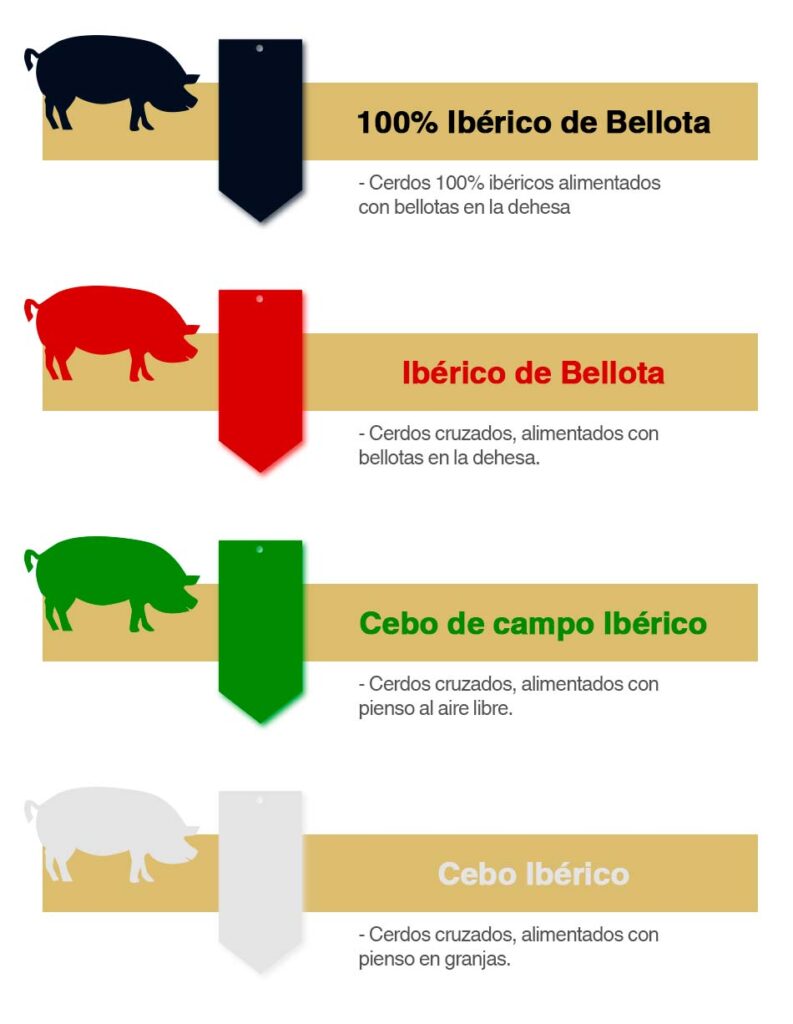
According to current regulations, there are four commercial labels that identify the classification of the Iberian pig:
- Black label: corresponds to 100% acorn-fed Iberian ham. It comes from purebred pigs raised freely in the dehesas and fed exclusively on acorns and natural resources.
- Red label: also refers to acorn-fed Iberian ham, but in this case, the pig has a breed percentage lower than 100%.
- Green label: indicates Iberian field-fed ham, from pigs fed on natural feed and pasture in semi-freedom.
- White label: used for grain-fed Iberian ham, raised on farms and fed controlled feed.
This classification helps consumers understand what they are buying and to appreciate the differences between pieces that, although they may appear similar, come from very different rearing conditions.
The production areas of Iberian ham also deeply influence these categories, as not all regions have the same access to dehesas or share the same climatic or geographical conditions.
The 4 Designations of Origin of the Iberian Pig in Spain
D.O.P. Dehesa de Extremadura
In the heart of the dehesas of Cáceres and Badajoz is born one of the most representative products of the gastronomic heritage of Extremadura. The acorn-fed Iberian ham under this designation is produced in a setting of natural pastures, holm oaks, and cork oaks, where the pig is raised in freedom and fed on acorns during the montanera season.
Its flavor is balanced, with intense notes of nuts and a juicy texture that melts in the mouth. This D.O.P. is a benchmark of excellence within the purest Iberian pig classification.
D.O.P. Guijuelo
Guijuelo, in the province of Salamanca, was the first D.O.P. recognized for Iberian ham in Spain. Its cold and dry microclimate allows for a slower curing, resulting in a soft, delicate, and slightly sweet product.
The hams and shoulders from this area come mainly from pigs fed on acorns and natural pastures, strictly following the criteria that define acorn-fed Iberian ham. Its profile is ideal for those seeking elegance and smoothness in every slice.
D.O.P. Jabugo
Located in the Sierra de Aracena and Picos de Aroche Natural Park, in Huelva, this designation is perhaps the most internationally emblematic. Formerly known as “Jamón de Huelva,” the D.O.P. Jabugo exclusively protects 100% acorn-fed Iberian hams.
The unique environment, with rich soils and constant humidity, allows for slow and even maturation. The result is an intense ham, with great flavor depth and lingering taste. A true jewel among the designations of origin of the Iberian pig.
D.O.P. Los Pedroches
The northern area of Córdoba hosts this designation, which stands out for the breadth and richness of its dehesas. The D.O.P. Los Pedroches guarantees an elegant acorn-fed Iberian ham, with a shiny fat and a milder flavor that is nonetheless complex.
Thanks to the careful classification of the Iberian pig in the region, an outstanding quality product is obtained—a true reflection of the balance between tradition and sustainability.
The Importance of D.O.P. in Choosing Iberian Ham
When choosing a good Iberian ham, the designations of origin of the Iberian pig serve as a reliable guide. It is not just a geographic indicator: behind each D.O.P. lie decades—or even centuries—of tradition, craftsmanship, and thorough control at every stage of the process.
Thanks to these seals, consumers can distinguish between products that share a name, but not necessarily quality. The D.O.P.s certify key aspects such as the pig’s diet, its traceability, the curing time, and the environmental conditions of the region. That’s why those who know the production areas of Iberian ham are better prepared to appreciate its nuances and choose wisely.
Furthermore, understanding the classification of the Iberian pig and its correspondence with each designation makes it easy to identify what lies behind labels like “100% Iberian acorn-fed” or “field-fed.” At Epicure, where we celebrate gastronomic excellence as a form of culture, we believe that knowing these details enriches not only the palate, but also the experience of enjoying a truly unique product.
Gastronomic Tourism with Epicure Society
Getting to know the designations of origin of the Iberian pig is more than a matter of labeling: it’s a way to understand, value, and better enjoy one of the most emblematic products of Spanish gastronomy. From the classification of the Iberian pig to the unique characteristics of each region, everything contributes to the experience offered by a genuine acorn-fed Iberian ham.
At Epicure Society, we know that each territory holds unique gastronomic secrets. That’s why we invite you to discover them firsthand with our gastronomic journey to Huelva. We’ll take you to the origin of the best Iberian ham in the world. You’ll learn everything about this gastronomic treasure—from the montanera in the dehesa to the salting process, including a unique natural drying shed where the ham is cured like a true gem. And, of course, you’ll end the experience with an unforgettable tasting.
Prefer something even more visceral and traditional? Our gastronomic expedition in Mallorca immerses you in an authentic Mallorcan matanza. You’ll take part in this rural celebration that revolves around the making of sausages like sobrasada, and spend a full weekend in the countryside with local meals, history, and culture.
Plus, once the sobrasadas are ready… we’ll send them to your home!
A unique experience, created for palates seeking more than just good food.
Because to truly taste, you must travel with intention.